 Skip to content
Discovering Diversity: The Difference Between Mashpi and the Amazon in Ecuador
While the Mashpi Reserve easily contends with the Amazon as a top Ecuador destination, most tourists that travel to Ecuador have never heard about this spectacular cloud forest. In the following article, we’ll lay out the characteristics that set the Mashpi Reserve apart and compare it to the more commonly-known Ecuadorian Amazon.
The Mashpi Reserve Complete Package: A Rainforest and Cloud Forest in One
Did you know that the Amazon isn’t the only rainforest in Ecuador?
The Andes mountain range divides Ecuador into three general regions: Pacific Coast, Andes and Amazon. If you were to track how the landscape changes as you travel from East to West (from the Pacific Coast to the Amazon), you’d be surprised to find that there are actually two types of rainforest and cloud forest in Ecuador: Coastal and Amazonian.
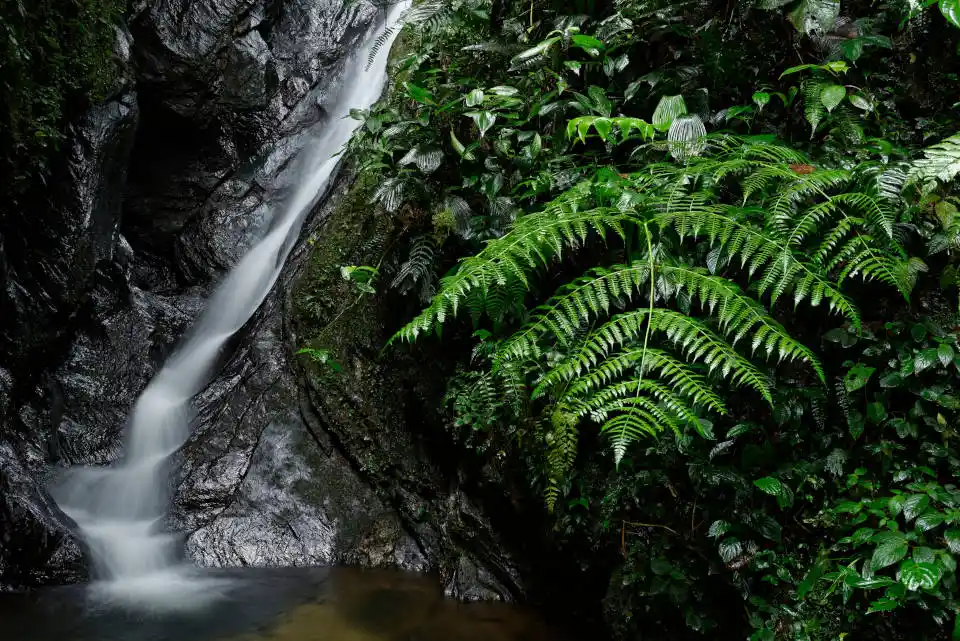
In Ecuador, the Mashpi Reserve is one of the few regions that encompasses both rainforest and cloud forest (as well as many other ecosystems). As you descend from the Andes traveling west, the montane forests give way to the cloud forest between 2,200 meters (7,218 feet) and at 900 meters (2,953 feet) above sea level. This cloud forest gradually transforms into a tropical, coastal rainforest that runs nearly all the way to Ecuador’s Pacific Coast. The total area of the Choco region (a major region in which the Mashpi Reserve is located) in Ecuador is approximately 47,000 km2 (18,146 mi2).
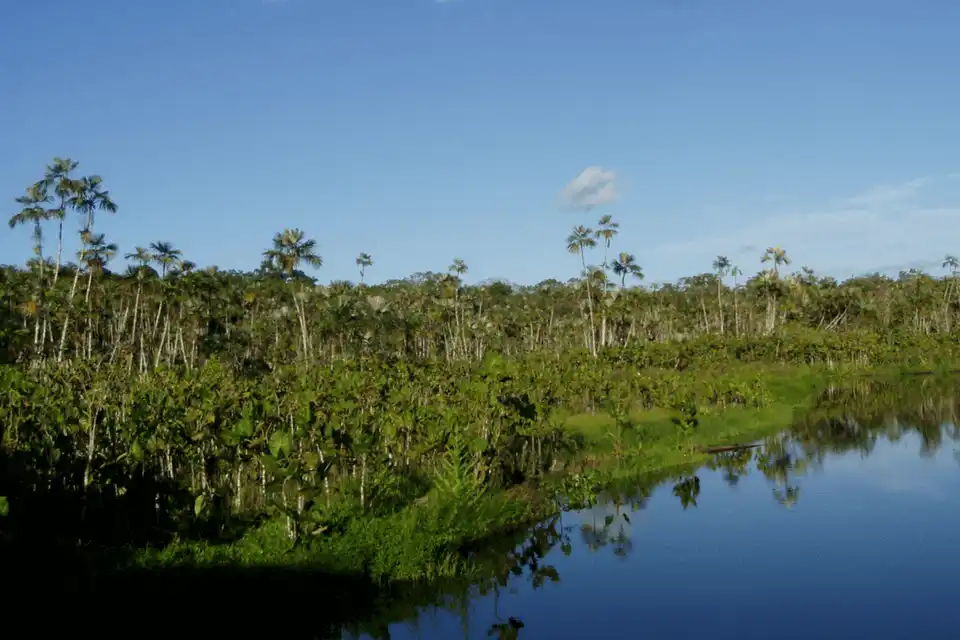
Conversely, a visit to the Amazon exposes you to only one type of forest: tropical rainforest. Beginning at the foothills of the Andes’ eastern slope, the Amazon rainforest covers an area almost as large as the continental United States and extends across nine South American countries. It offers an incredible wealth of flora and fauna as well as opportunities to discover indigenous cultures, but reaching it is slightly complex and certainly time-consuming. How much you manage to see during your fleeting vacation is clearly an important factor when choosing a destination. This leads many visitors to decide to focus their journey on the Cuyabeno Wildlife Reserve, which is located in the Ecuadorian Amazon along the Colombian border.
Part of the Amazon Basin, Cuyabeno harbors a large diversity of wildlife within a concentrated area that’s characterized by floodplains at the foothill of the Andes. In a four-day trip, you might see a large part of the animal species on your Amazon bucket list. The downside to visiting this area (beyond time issues), however, is that it isn’t a very exclusive experience, and for every outing you’ll likely have to squeeze onto a small motor-powered canoe with 20+ other tourists.
In comparison, the Mashpi Reserve offers visitors an exclusive experience with access to both the rainforest and cloud forest in Ecuador, guaranteeing numerous wildlife sightings within a short amount of time.
The Great Divide: The Andes Mountain Range
To get a clearer picture of why the Amazon and the Mashpi Reserve in Ecuador are so different, it’s necessary to travel back in time by a few million years. Around 60 million years, to be more precise. At that time, the Andes mountain range began to rise from the continent, reaching its full height around 10 million years ago.
As the Earth’s longest continental mountain range, the Andes functioned as a physical barrier between East and West. This natural “great wall” created geographic isolation between species on either side of the range, preventing their interaction, and leading to speciation (the formation of new and distinct species in the course of evolution).
This continental barrier is also responsible for the change in climate between the two regions: the Andes blocked the flow of humid air from the Atlantic coast and kept water from draining into the Pacific. The massive amount of humidity and water that accumulated west of the Andes is responsible for the modern-day Amazon Basin and the namesake river that drains into the Atlantic Ocean.
On the western side of the Andes, new high-elevation habitats and environmental conditions were formed. Among these is the Mashpi Reserve’s rainforest and cloud forest.
The rise of the Andes is a fascinating (and controversial) topic that goes beyond the scope of this article. If you’re interested in learning more, then be sure to read this ScienceMag post.
Speciation between Amazon species and the Mashpi Reserve’s cloud forest animals
The process that led to the formation of the Andes mountain range resulted in impressive levels of speciation, with significant differences found when comparing the animals of the Ecuadorian Amazon and Mashpi Reserve cloud forest. However, since many of them share a common ancestor, striking similarities are also apparent. The following three examples provide a small glimpse into some of the evolutionary changes that took place between similar species across both regions:
Long-wattled Umbrella bird
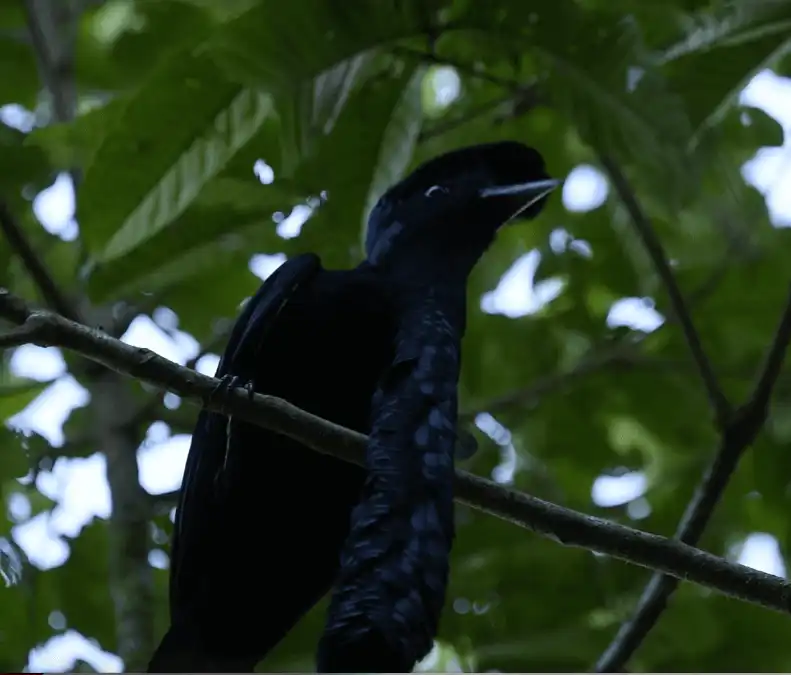
Another bird with a similar story is the magnificent, and rare, long-wattled umbrellabird (Cephalopterus penduliger).
To attract its mate, the male long-wattled umbrella bird is adorned with a crest and a large throat wattle. If you’ve never seen a throat wattle, it’s time you did. By drawing so much attention to itself, the male umbrella bird makes itself more vulnerable to predators. Fortunately, the length of its wattle can be controlled, and is always retracted in flight.
Between the Mashpi Reserve and the Amazon, the differences between umbrella wattle-bird species were significant enough to classify them as separate species. In appearance, they strongly resemble one another, but the Amazonian species (Cephalopterus ornatus) is noticeably larger.
You can see the bird yourself at Mashpi Lodge!
3 species you’ll see only in the Mashpi Reserve’s cloud forest
The Amazon’s sheer magnitude manifests in numerous ways.
In breadth, the Amazon rainforest extends over thousands of kilometers, crossing over eight political borders. In depth, the Amazon River can be up to 100 meters (328 feet) deep and, in certain parts, can even be navigated by large steamboats. In height, the Amazon canopy is nearly as high as a 14-story building, averaging a whopping 30-45 meters (100-150 feet)!
Everything in the Amazon is just… bigger, including the animals that dwell there. Among the more popular Amazonian inhabitants are the jaguar, the pink dolphin, the tapir, bird-eating tarantulas, and man-eating piranhas (which, by the way, are generally harmless in spite of their aggressive name).
The Mashpi Reserve’s cloud forest, in contrast, harbors much smaller animal species. Many of these species are endemic to the Choco bioregion (the bioregion that the Mashpi Reserve sits in); that is, they can only be found in the Choco cloud forest region and nowhere else in the world. In fact, among the reptiles and amphibians found in the Choco, nearly 40% are endemic.
The Mashpi Reserve within the Ecuadorian Choco is a pristine, unspoilt tract of the Choco where, if you’re lucky, you might have the opportunity to see a few of the following endemic creatures:
“Cutin Adornado” (Pristimantis ornatissimus)
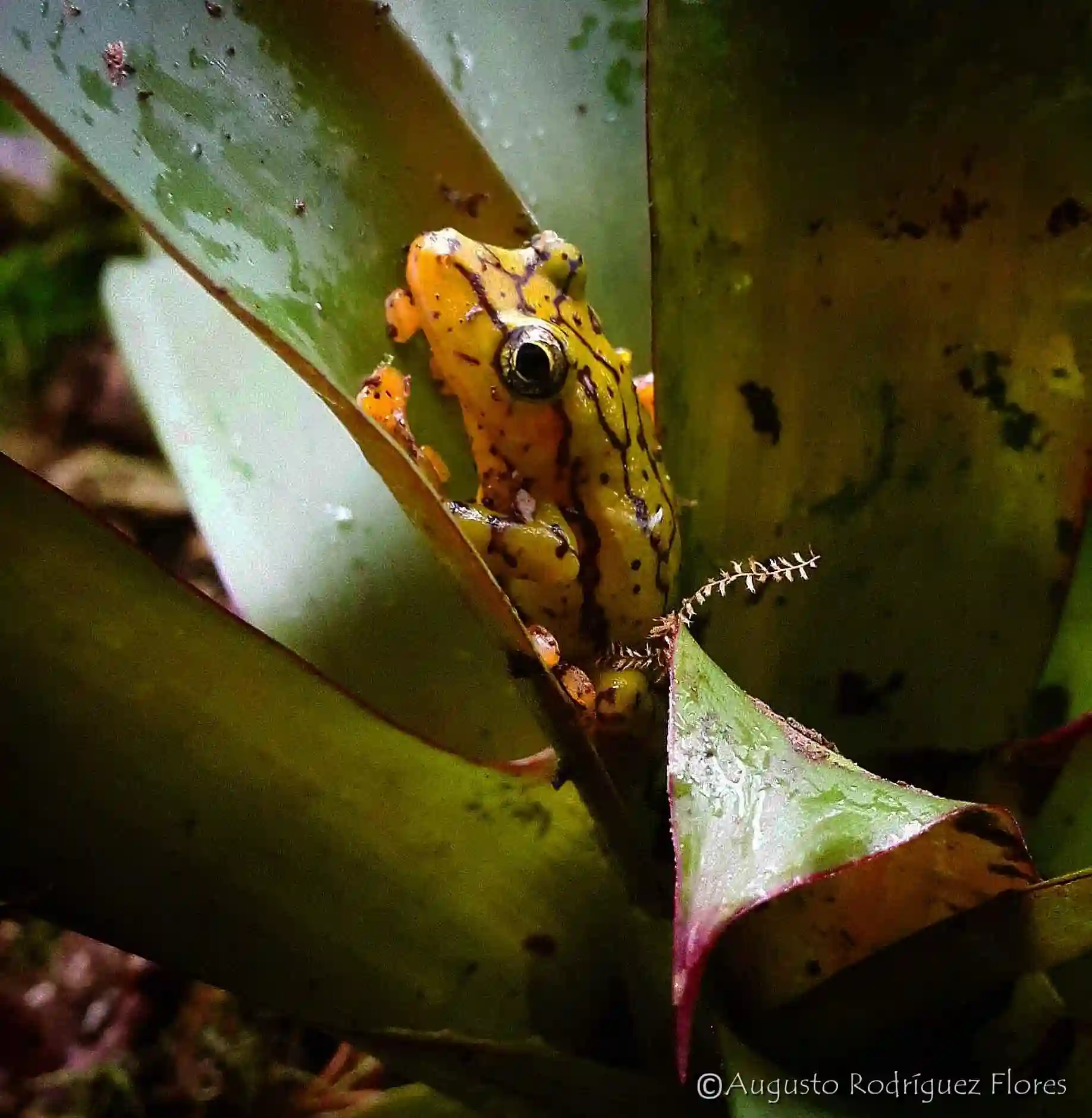
Pristimantis ornatissimus is a small tree frog endemic to the north-western flank of the Andes (between 400-1,800 meters [1,312 – 5,905 feet] above sea level).
Due to its bright yellow coloration, the frog is thought of as a jewel in the forest. This also helps to explain its name: in Latin, ornatus means decorated or ornate. In fact, even the local nickname used to describe the frog, cutin adornado (adorned “cutin”), refers to its decorative colors.
A nocturnal and arboreal species, Pristimantis ornatissimus lives in large leaves and bromeliads. Unfortunately, as is too often the case these days, it is now on the world’s vulnerable species list due to habitat loss and deforestation and, as an amphibian, it is especially vulnerable to agricultural pollution.
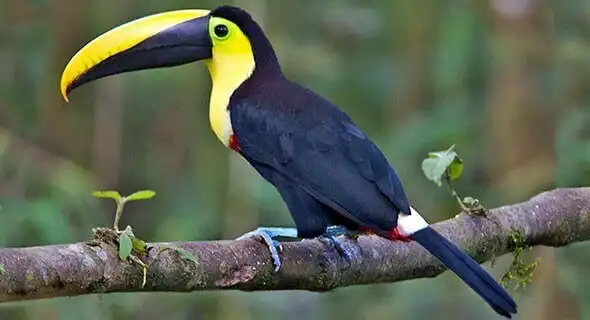
Choco Toucan (Ramphastos brevis)
This bright toucan is endemic to the Choco forests, as its name implies. Unlike Pristimantis ornatissimus (described above) frequent sightings of the Choco Toucan attest to the population’s overall health. That being said, according to the IUCN Red List of Threatened Species, this toucan’s population appears to be decreasing. The good news, however, is that its species is spread out over a wide region and is therefore exposed to less immediate risk.
The Choco toucan is a large, striking bird. Its yellow and black beak is conspicuous, as well as its call, which sounds more like a croak than an actual call. In the forest, these birds are known to cause quite a racket, especially when flocking together. There’s something about a toucan’s colors, beak and character that delight birders and non-birders alike.
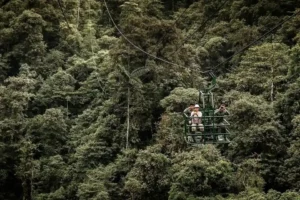
In the Mashpi Reserve, one of the best places to spot the toucan is from the Dragonfly, a cloud forest cable car at Mashpi Lodge that inserts you right into the forest canopy.
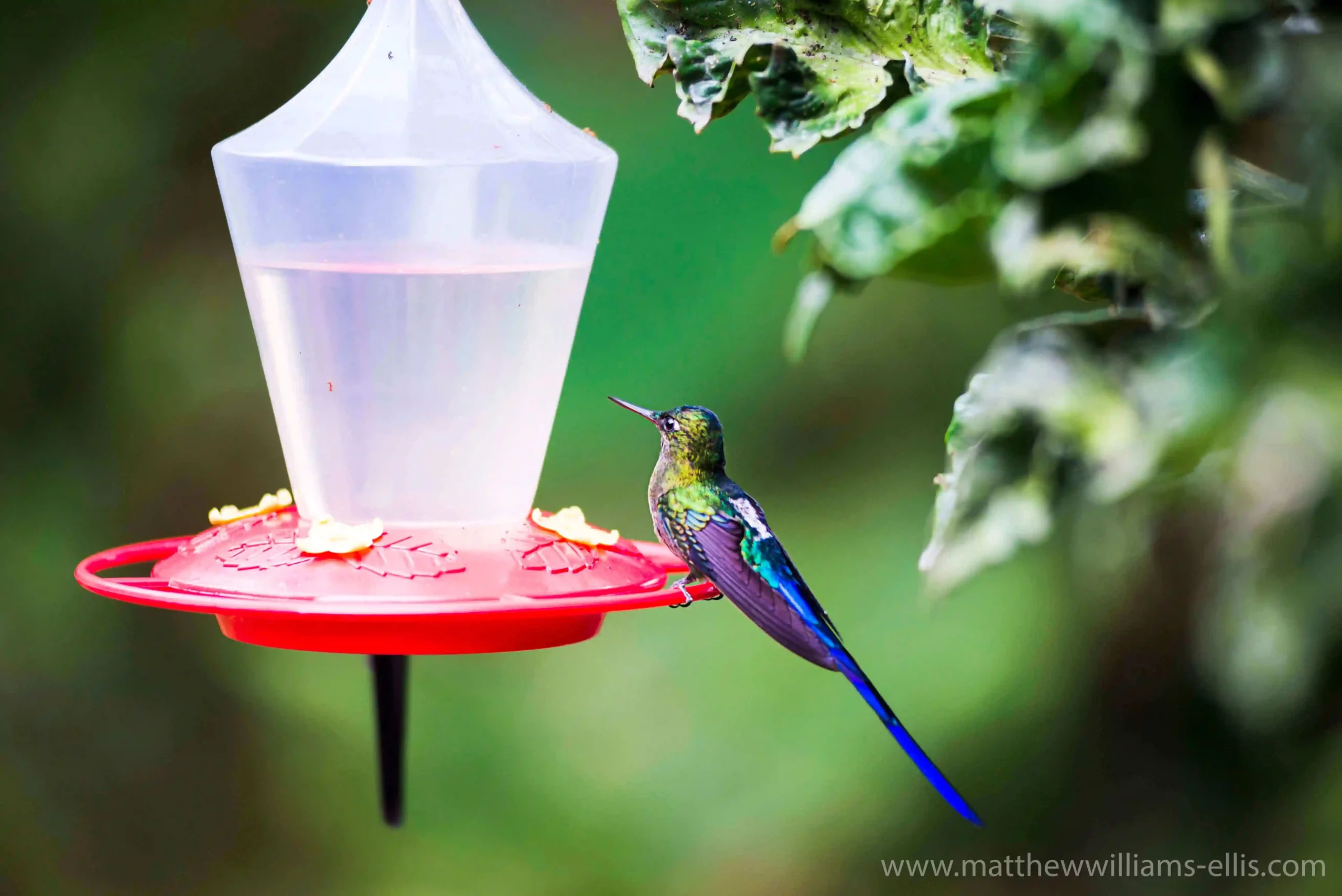
Violet-tailed sylph (Aglaiocercus coelestis)
Along the Mashpi Reserves upper cloud forest, at around 900 meters (3,000 feet), birdwatchers may have the distinct privilege of spotting yet another endemic bird species: the violet-tailed sylph. Named after the male’s stunning, long, and resplendent tail, this little bird species maintains a stable population and is not at risk.
Like the other animals on this short list of endemic Choco species, the violet-tailed sylph can only be sighted in the Choco, thriving in its mossy forest. It lives here year-round and can be spotted frequenting the sweet water feeders around Mashpi Lodge.
Wrapping up…
If you hadn’t considered visiting Mashpi Reserve’s rainforest and cloud forest before, it’s time you did.
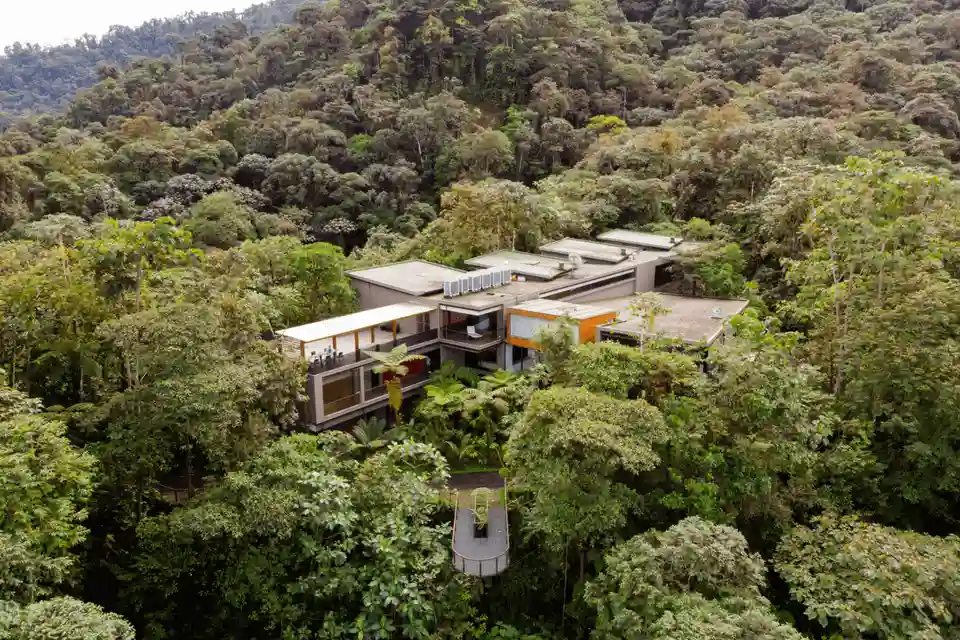
Only a fraction of the size of the Amazon, the Mashpi Reserve is an important piece of one of the most biologically diverse ecosystems in the world! In Ecuador, the Mashpi Reserve’s natural wealth is concentrated in an accessible and exclusive reserve, just a three-hour drive from the country’s capital.


2 Responses
I stayed there in February with my children and grandchildren. It is a remarkable place to visit. The hotel is beautiful but the rain forest is pristine and amazing. Be prepared to hike up and down the mountain and also thru rivers and river beds. Night time hikes into the forest are also fascinating.
Dear David,
Thank you so much for your feedback! We’re so glad you got to enjoy your stay at Mashpi Lodge!
Have a great day!